


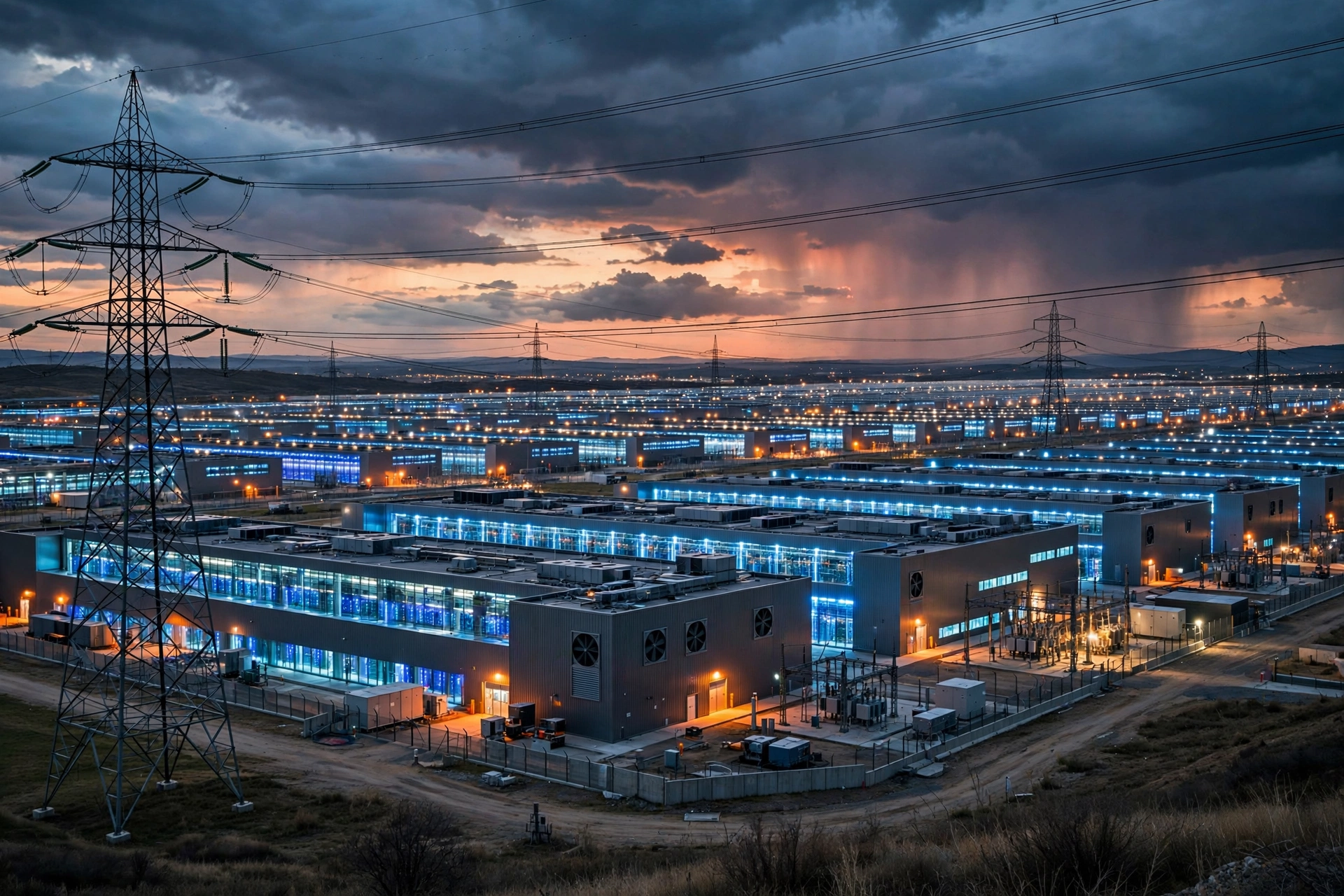
Artificial intelligence feels weightless when you use it. You type a question, wait a second, and an answer appears. Behind that simple moment, however, sits one of the heaviest industrial build-outs in modern history: vast data centres filled with specialised chips, cooled around the clock and powered like small cities. This week the economics of that build-out are back in the spotlight, after analysts pointed out an uncomfortable piece of arithmetic — paying for AI’s planned data centres at today’s wages would, on paper, take more workers than the United States actually has. The point is not that anyone plans to pay for them that way. The point is that the scale of spending now rivals the scale of entire labour markets.
A building boom measured in gigawatts
Technology companies are racing to secure land, electricity and graphics processors at a pace few industries have ever attempted. Hyperscale campuses that once took years to plan are being announced in clusters, often in regions offering cheap power, available grid capacity and fast permitting. Each new facility needs substations, transmission lines, backup generation, cooling systems and thousands of kilometres of fibre. As our explainer on how fibre internet works shows, connectivity is only one layer of a much larger physical stack.
The International Energy Agency has warned that electricity demand from data centres is set to grow sharply this decade, with AI the main driver. Its Energy and AI report sets out how concentrated that demand is: a single large campus can draw as much power as a mid-sized town, and clusters of campuses can strain grids that were planned long before the AI boom.
Why the maths looks so strained
The tension is simple to describe and hard to solve. Building and equipping data centres costs hundreds of billions of dollars, while the revenue from AI services, though growing fast, is still catching up. Forecasts for infrastructure spending now outstrip many estimates of near-term AI income, which is why sceptics talk about an AI maths problem. Investors are effectively paying today for capacity they hope will be filled by products, subscriptions and enterprise contracts that do not yet exist at the required scale.
There is also a timing problem. Chips are ordered years in advance, power contracts run for decades, and buildings last a generation. If demand grows more slowly than expected, owners are left with expensive assets that cannot easily be repurposed. If demand grows faster, companies that underbuilt lose ground to rivals. That fear of losing is a powerful motivator, and it helps explain why spending keeps rising even as the warnings get louder.
Who ultimately pays?
In the first instance, shareholders pay, through the enormous capital budgets of the largest technology firms. Increasingly, though, the bill is being shared. Private credit funds, infrastructure investors and sovereign wealth funds are financing campuses through complex deals that move assets off balance sheets. Electricity customers may pay a share too, if utilities raise rates to fund grid upgrades built mainly for data centre customers — a debate already live in several US states, where regulators are asking whether households should subsidise the power needs of the world’s richest companies.
Workers feel the effects in both directions. Construction of these sites creates thousands of temporary jobs, and finished campuses employ technicians, engineers and security staff, though far fewer people than a factory of similar cost. At the same time, the AI systems housed inside are being sold partly as a way to automate office work, which is why the comparison between data centre spending and national employment lands so hard. One widely shared estimate framed the planned spend as the equivalent of hundreds of millions of jobs — more than America’s roughly 159 million workers — not as a literal payroll, but as a measure of how much human labour the investment represents.
Efficiency is the pressure valve
The industry’s answer is efficiency. Newer chips deliver far more computation per watt than the hardware they replace, and model developers are learning to train and run systems with less raw computing power. Techniques such as distillation, sparsity and better data curation can cut costs dramatically. Cooling is improving too, with liquid systems replacing energy-hungry air conditioning in the densest halls. If efficiency gains outpace demand growth, the infrastructure bill becomes manageable. If demand always expands to fill the available capacity, as it has so far, the bill keeps climbing.
Security and reliability add further cost. Facilities must protect valuable hardware and sensitive data, which is one reason account and access security matters at every level of the stack — a theme we explored in our guide to passkeys replacing passwords.
What to watch next
Three signals will show whether the maths is improving. First, whether AI revenue at the major cloud providers grows fast enough to cover depreciation on their hardware. Second, whether power regulators make data centres pay the full cost of the grid capacity they reserve. Third, whether a new generation of more efficient models reduces the amount of infrastructure each AI answer requires. Until those answers are clear, the boom will continue to look like what it is: a spectacular engineering achievement, and an open financial question. The data centres are real, the demand is real — and so is the bill.
