


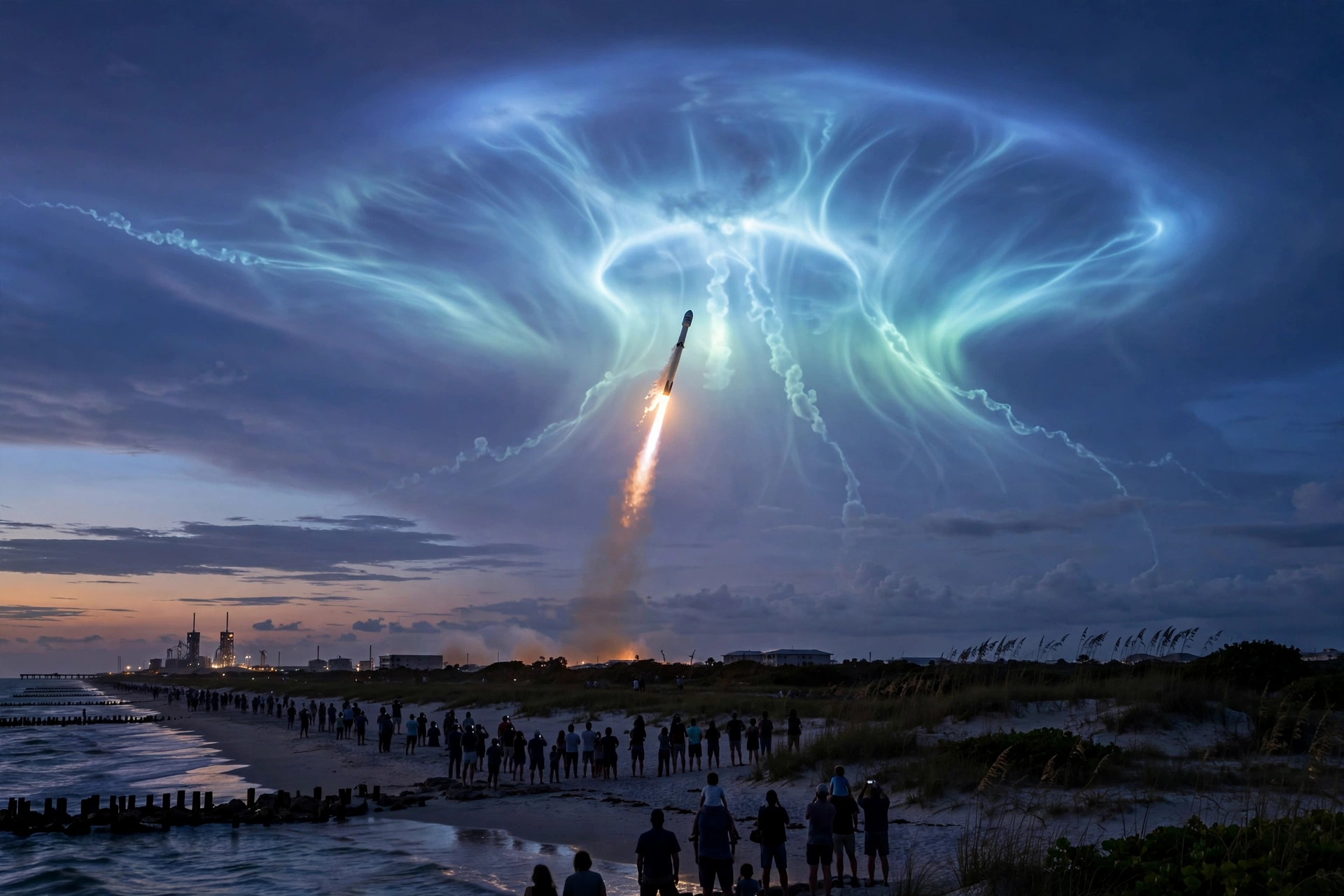
People along the US east coast who stepped outside after a recent SpaceX launch were treated to a sight that looked more like science fiction than rocket science: a vast, glowing, jellyfish-shaped cloud hanging high in the twilight sky, its translucent tentacles drifting slowly apart. Photos and videos spread quickly across social media, with many viewers wondering whether they were looking at a comet, a strange weather formation or something stranger still. In fact, they were watching one of the most beautiful side effects in spaceflight — the so-called jellyfish phenomenon.
What exactly did people see?
The display followed a SpaceX rocket launch in the hours around dawn or dusk, the timing that makes the effect possible. As reporting on the launch described, the rocket’s exhaust plume expanded high above the coast and caught the sunlight, producing a luminous cloud shaped uncannily like a jellyfish: a bright, rounded head with long, faint trails streaming behind it. Because the rocket was so high, the plume remained sunlit long after the ground below had fallen into shadow.
The science of the twilight phenomenon
The jellyfish effect, often called the twilight phenomenon, happens when a rocket climbs into the upper atmosphere shortly before sunrise or after sunset. Down on the ground it is dark, but tens of kilometres up, the sun is still shining. Exhaust gases and tiny ice crystals released by the rocket expand rapidly in the near-vacuum, forming a huge, thin cloud. Sunlight striking that cloud makes it glow against the darkening sky, while the rocket’s motion stretches it into the familiar bell-and-tentacles shape.
Upper-atmosphere winds then do the artwork. Different layers of air move at different speeds and in different directions, twisting the plume into ribbons and curls. The colours can shift too, from bright white to soft gold and pink, depending on the angle of the sun and the composition of the exhaust. No chemicals are being sprayed and nothing is burning in the sky — it is simply sunlight, water vapour and physics, performed on a very large scale.
Why the east coast gets such good seats
Launches from Florida’s space coast are ideally placed for these displays. Rockets climb north-east over the Atlantic, gaining altitude quickly while coastal cities from Florida to the Carolinas and beyond still have a clear line of sight. On a clear evening, the plume can be visible across several states, which is why a single launch can generate thousands of photographs from people hundreds of kilometres apart. The same geometry that makes the coast a great place to watch launches also makes it a great place to build the networks that carry those images — something we looked at in our explainer on fibre internet.
Not the first, and not the last
Jellyfish clouds have been recorded after launches for decades, and they have startled plenty of people along the way. A famous SpaceX launch over California in 2017 prompted a flood of calls to authorities from drivers who thought they were seeing something unexplainable. Similar displays have followed launches in Russia, China and New Zealand. What has changed is the frequency: with commercial launch rates at record levels, spectacles that were once rare are becoming a regular feature of coastal skies.
That regularity is part of a bigger shift in how people experience spaceflight. Launches were once distant television events; now they are neighbourhood events, watched from driveways and beaches and shared within minutes. If you plan to watch the next one, a short break from your phone until the moment itself can make it even more striking — a point backed by research in our piece on the science of a digital detox.
How to catch the next one
The recipe is straightforward. Pick a launch scheduled within about an hour of sunrise or sunset, find a spot with a clear view towards the launch site and a dark sky, and look up a few minutes after lift-off. The display usually appears as the rocket reaches high altitude, and it can last for several minutes as the plume expands and fades. Binoculars help reveal the structure, but no equipment is required — the cloud can span a startling portion of the sky.
Scientists, incidentally, value these plumes as more than a spectacle. Tracking how exhaust clouds drift and disperse helps researchers study winds and conditions in a part of the atmosphere that is difficult to measure directly. So the next time a glowing jellyfish blooms over the coast, enjoy it for what it is: a free light show, a small lesson in atmospheric science, and a reminder that the space age now unfolds, quite literally, over our own back gardens.
